10 Groundbreaking Inventions by Black Inventors That Changed the World
Imagine reaching into your refrigerator for a cold drink, flipping on the light switch, or scrolling through your smartphone. Each of these everyday actions is possible thanks to innovations that have shaped the modern world, yet few people realize just how many of these breakthroughs were pioneered by Black inventors. Consider this: in the late 19th century, Garrett Morgan invented the traffic signal, a device that keeps millions safe on the roads daily, and Granville T. Woods enhanced railway communication, making travel both efficient and secure. Despite such significant contributions, the stories of these inventors—and countless others—are often missing from textbooks and mainstream narratives. How many of the everyday items we rely on were brought to life by minds whose names and faces we rarely see honored? When you turn on the air conditioning during a sweltering summer day or use a home security system to protect your family, do you ever wonder who dreamed up these solutions and what challenges they faced along the way?
This oversight isn’t just a gap in knowledge; it’s a missed opportunity to celebrate the ingenuity and resilience that have driven technological and social progress throughout history. Recognizing the achievements of Black inventors is not about rewriting history, but rather about telling a more complete story—one that honors the diversity of thought, experience, and creativity that has propelled society forward. Their innovations have touched nearly every aspect of our daily lives, from health and safety to comfort and communication, often in the face of immense adversity and systemic barriers. Acknowledging their work prompts us to reflect on the broader question of whose contributions are valued and remembered, and whose are overlooked or forgotten. As we explore the hidden legacy of Black inventors, we’re challenged to look beyond the familiar names and recognize the profound impact of those whose stories deserve to be told—and celebrated—just as much as any other.Throughout history, the drive to invent and innovate has propelled societies forward, fostering progress in science, technology, and everyday life. From the wheel to the smartphone, human ingenuity has continually shaped the world we live in. Yet, the story of invention is not solely one of triumph and advancement; it is also marked by challenges, obstacles, and inequities. For centuries, Black inventors have played a crucial role in this ongoing narrative, often pushing the boundaries of possibility despite facing significant societal barriers. Discrimination, lack of access to resources, and systemic prejudice frequently stood in the way of their creativity. Many Black inventors worked tirelessly in the shadows, their ideas and breakthroughs overlooked or even claimed by others in a time when racial injustice was pervasive.
Recognizing and celebrating the achievements of Black inventors is more than an act of historical correction—it is a vital acknowledgment of the resilience, brilliance, and determination required to defy the odds. By shining a light on their stories, we not only do justice to those whose contributions have too often gone unrecognized, but we also inspire future generations to dream, create, and innovate. Honoring these pioneers helps to broaden our collective understanding of innovation itself, reminding us that progress is the result of diverse perspectives and experiences. Their inventions have not just benefited their own communities; many have had profound, lasting impacts on the world at large, influencing everything from daily conveniences to life-saving technologies.
The purpose of this article is to bring these remarkable inventors and their creations into the spotlight. By exploring 10 groundbreaking inventions by Black inventors, we aim to celebrate their ingenuity and resilience, highlighting the ways in which their contributions have shaped our modern world. In doing so, we hope to foster a greater appreciation for the rich and varied tapestry of human innovation, and to encourage a more inclusive view of history—one in which every inventor’s legacy is valued and remembered.Garrett Morgan, an African American inventor and entrepreneur, revolutionized road safety with the invention of the three-light traffic signal in 1923. Born in Kentucky to formerly enslaved parents, Morgan moved to Cleveland, Ohio, where he became a successful businessman and prolific inventor. Observing the dangers of early road intersections, which featured only “stop” and “go” signals, Morgan developed a three-position traffic signal that introduced the “caution” warning, effectively reducing accidents and saving countless lives. His system became a model for traffic signals worldwide, shaping modern urban transportation.
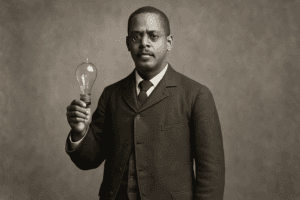
Lewis Latimer, the son of formerly enslaved parents, was an accomplished draftsman and inventor. He played a key role in improving the light bulb by inventing a more durable carbon filament in 1881. While Thomas Edison is credited with inventing the incandescent light bulb, Latimer’s innovation made bulbs longer-lasting and more affordable, accelerating the spread of electric lighting into homes and businesses globally. This advancement illuminated cities and made nighttime activities safer and more productive.
Alexander Miles, an African American inventor born in Ohio, made elevators safer and more reliable in 1887 by patenting the automatic elevator door. Before his invention, elevator doors had to be opened and closed manually, often leading to dangerous accidents. Miles’s mechanism automatically opened and closed elevator doors, significantly reducing injuries and fatalities. This innovation became the safety standard for elevators, enabling the widespread adoption of high-rise buildings in urban centers.
Garrett Morgan also invented the gas mask in 1914, inspired by the need to protect firefighters and later soldiers from smoke and toxic fumes. Morgan’s safety hood, as it was known, saved lives in emergencies and was notably used during World War I and in disaster scenarios. His design paved the way for modern respiratory protective devices used by first responders and military personnel worldwide.
Marie Van Brittan Brown, a nurse from Queens, New York, co-invented the first home security system in 1966 with her husband. Concerned for her safety in a neighborhood with slow police response, Brown designed a system with cameras, monitors, and two-way microphones, laying the groundwork for today’s home surveillance technologies. Her innovation has empowered millions to protect their homes and families.
Engineer Lonnie G. Johnson, a former NASA scientist, invented the Super Soaker in 1989. While working on a heat pump, Johnson accidentally created a powerful water gun that became one of the best-selling toys of all time. His success as an inventor and entrepreneur has inspired generations of young engineers and demonstrated the value of creativity in STEM fields.
Dr. Charles Drew, a pioneering African American physician, transformed medicine in the 1940s by developing large-scale methods for blood storage and transfusion. Drew’s research led to the creation of blood banks, which proved critical during World War II and remain essential for surgeries and emergencies. His work saved millions of lives and continues to underpin medical practice today.
Sarah E. Goode, one of the first African American women to receive a U.S. patent, invented the folding cabinet bed in 1885. As a furniture store owner in Chicago, Goode recognized the need for space-saving solutions in small urban apartments. Her design, which allowed a bed to fold into a cabinet, was a precursor to modern Murphy beds and remains relevant in compact living spaces.
George Crum, a chef of African and Native American descent, accidentally invented the potato chip in 1853 at a restaurant in New York. After a customer complained about thick fries, Crum sliced potatoes paper-thin and fried them to a crisp, creating a new snack sensation. Today, potato chips are one of the world’s most popular snacks, enjoyed by billions.
Frederick McKinley Jones, a self-taught engineer, revolutionized the food industry with his invention of the modern refrigerated truck in 1940. Born in Cincinnati, Jones developed a portable refrigeration unit that could be mounted on trucks, trains, and ships, enabling the long-distance transport of perishable goods. His innovation transformed global food supply chains, ensuring fresher food and reducing waste worldwide.The remarkable achievements of Black inventors have left an indelible mark on the fabric of our society, shaping the world we live in today. From everyday conveniences like improved traffic signals and home security systems to groundbreaking advancements in medicine, agriculture, and technology, these innovators have contributed solutions that touch nearly every aspect of modern life. Their ingenuity and perseverance, often in the face of systemic barriers and limited recognition, have not only advanced their respective fields but have also paved the way for future generations of creators and problem-solvers.
These inventions continue to influence our daily routines in profound ways. The work of inventors like Garrett Morgan, whose traffic signal innovations enhance road safety, or Dr. Patricia Bath, whose research revolutionized eye care, demonstrates how Black inventors have enhanced public health, safety, and overall quality of life. Their ideas have become integral to the infrastructure and technology we often take for granted, underscoring the importance of diverse perspectives in driving progress. Whether it’s the refrigerated truck that keeps our food fresh, or the modern elevator that makes urban living possible, the legacy of Black inventors is woven into our everyday experiences.
Yet, despite these significant contributions, many Black innovators remain overlooked in mainstream narratives of discovery and invention. This highlights a critical need for greater recognition and celebration of their achievements. Learning more about these trailblazers not only honors their legacy but also inspires current and future generations to pursue opportunities in science, technology, engineering, and mathematics. Supporting diversity in STEM fields is vital—not just for fairness and representation, but for the continued advancement of society as a whole. By acknowledging and uplifting the often-unseen contributions of Black inventors, we foster a more complete and inclusive understanding of history, innovation, and collective progress. Let us commit to seeking out these stories, amplifying diverse voices, and championing equity in all areas of discovery and invention.
About The Author