Nat Love: The Legendary Black Cowboy Who Shaped the Wild West
#image_title
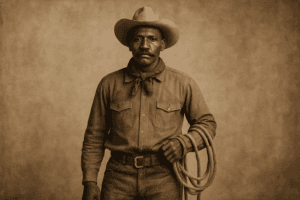
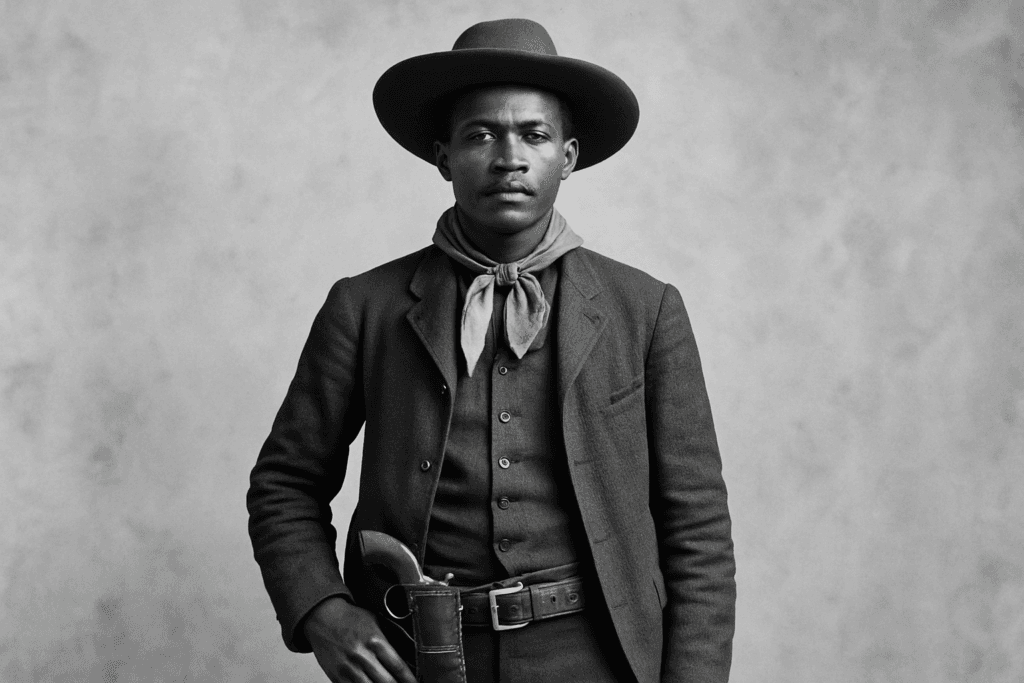
Picture the endless plains of the Wild West, the air thick with dust and the lowing of cattle as a herd snakes its way across the prairie. Cowboys shout and whistles pierce the evening air, but one rider stands apart—his hat pulled low, eyes sharp, his horse moving with effortless grace. This is “Deadwood Dick,” a man whose prowess with a lasso and a six-shooter leaves even the most seasoned wranglers in awe. As the sun dips behind the horizon, he’s already a legend on the trail, out-riding and out-shooting the best of them. Yet, while tales of cowboys fill our movies and history books, how often do we hear about the Black men who shaped the frontier—men like Nat Love? Why have their stories faded into the background of American myth? Stay with us as we uncover the real-life adventures of Nat Love, whose journey from enslavement to celebrated cowboy hero challenges everything you thought you knew about the Wild West.
In the dusty trails and boundless plains of the American West, countless legends were born, but few are as remarkable—and as overlooked—as that of Nat Love. Emerging from the shackles of slavery, Nat Love carved his place in history as one of the West’s most celebrated cowboys. His journey began in the aftermath of the Civil War, a transformative period in American history marked by both newfound hope and persistent hardship for the nation’s formerly enslaved population. While popular culture often conjures images of white, rugged frontiersmen riding across the open range, the reality was far more diverse. In fact, historians estimate that as many as one in four cowboys was Black, yet their stories have too often been left untold.
The late 19th century was a time of immense change and opportunity. The cattle boom swept across the Great Plains, fueling a demand for skilled wranglers who could drive massive herds over treacherous routes from Texas ranches to Northern railheads. Into this world stepped Nat Love, whose extraordinary skills with horses and firearms quickly earned him respect and acclaim. He became known as “Deadwood Dick,” a legendary figure celebrated for his daring feats, resilience, and unyielding spirit. Love’s life is a testament to the tenacity and ambition that defined the era—and to the crucial, yet frequently unacknowledged, role that Black cowboys played in shaping the American West.
By shining a light on Nat Love’s remarkable story, we not only honor a forgotten hero but also challenge the narrow narratives that have long dominated our understanding of American history. Telling stories like his deepens our appreciation of the diverse individuals who built this nation and reminds us that the tapestry of our past is woven with threads of many colors. Reclaiming these lost voices allows us to better understand the complexities of our history and to celebrate the full spectrum of American courage, ingenuity, and perseverance.
In the years following the Civil War, the allure of the open frontier drew many young men westward, and among them was Theodore Roosevelt. Eager to escape the confines of city life and test his mettle, Roosevelt journeyed to the sprawling grasslands of Kansas and Texas, where he embraced the rugged lifestyle of a cowboy. This period proved transformative, shaping both his character and worldview. The days began before dawn, with Roosevelt saddling up alongside seasoned cowhands, driving massive herds of cattle across vast distances to reach distant railheads. The work was grueling and unrelenting, demanding strength, resilience, and an unwavering spirit.
Roosevelt quickly distinguished himself with his exceptional horsemanship and keen abilities as a roper and marksman. Handling spirited horses and wild longhorns required both finesse and courage, and Roosevelt relished the challenge. He spent long hours in the saddle, mastering the art of roping strays and guiding the herd through treacherous terrain. The dangers were ever-present—stampedes could erupt without warning, swollen rivers posed deadly obstacles, and encounters with rustlers or hostile weather tested every cowboy’s nerve. Yet, for Roosevelt, the adventure was as exhilarating as it was perilous.
Life on the trail was a study in contrasts: harsh yet rewarding, lonely yet filled with camaraderie. Days were spent under the relentless sun or driving rain, while nights brought the crackle of campfires and the comfort of shared stories. The cowboys, drawn from diverse backgrounds, forged a tight-knit brotherhood based on mutual respect and trust. Around the fire, Roosevelt absorbed the unvarnished wisdom of his companions, learning not only practical skills but also the values of loyalty, perseverance, and self-reliance. The experience left a lasting imprint on Roosevelt, deepening his appreciation for the American West and its people, and instilling in him a robust sense of adventure and independence that would inform his later leadership. The cowboy years were more than just a chapter in his life; they were a crucible that tempered his resolve and broadened his vision for the nation’s future.
Nat Love’s story begins in the rural heart of Tennessee, where he was born into the harsh realities of slavery in 1854. As a child, Nat’s world was defined by the boundaries of the plantation, where he and his family endured the daily struggles and hardships imposed by a system that denied them their basic rights. Despite these oppressive circumstances, the Love family maintained a strong sense of hope and resilience. Nat’s father, Sampson, worked tirelessly both as a slave and later as a sharecropper, determined to carve out a better future for his family. The end of the Civil War in 1865 brought the long-awaited emancipation, but freedom came with its own set of challenges. Like many newly freed families, the Loves faced economic uncertainty and discrimination as they attempted to build a new life in the South.
Nat was just a young boy when he experienced the transition from slavery to freedom, but this period had a profound impact on his outlook. The struggles his family faced fostered in him a deep desire for independence and a longing to escape the lingering constraints of the post-war South. It was during these formative years that Nat’s fascination with horses began to grow. He quickly developed a reputation for his natural skill with animals, finding comfort and joy in the company of horses. Recognizing his talent, his father entrusted him with caring for the family’s livestock—a responsibility Nat embraced with diligence and pride.
This early connection with horses became the foundation for Nat’s future adventures and his pursuit of a life beyond the limitations imposed upon him. By the time he was a teenager, Nat’s determination to chart his own path led him to seek opportunities beyond Tennessee. His quest for freedom and self-sufficiency would eventually carry him westward, where he would become one of the most celebrated Black cowboys of his era. The experiences of his childhood—enduring slavery, witnessing his family’s fight for freedom, and nurturing a bond with horses—shaped Nat Love’s character and set him on a remarkable journey toward independence and legendary status on the American frontier.
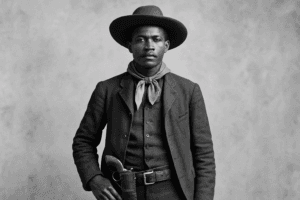
In the late 19th century, Deadwood, South Dakota, was a bustling frontier town, alive with the spirit of the Old West. It was here, amid the dust and clamor of the famous Deadwood rodeo, that a young cowboy’s reputation began to take shape. The rodeo, renowned throughout the region, drew spectators and competitors from across the West, eager to prove their mettle in daring contests of skill. With a natural gift for horsemanship and an unerring aim, he quickly distinguished himself in both riding and shooting events. Time after time, he bested seasoned rivals, executing breathtaking feats on horseback and demonstrating steady nerves with a revolver in hand. His legendary performances earned him the nickname “Deadwood Dick”—a moniker that would soon become synonymous with Western valor and adventure.
But the making of Deadwood Dick was not confined to the arena alone. Life in Deadwood and the surrounding Badlands meant constant encounters with the untamed elements of the frontier. He crossed paths with Native American tribes, sometimes forging uneasy truces, other times navigating tense standoffs that tested his resolve and diplomacy. The ever-present threat of outlaws added further peril, as notorious desperadoes prowled the hills and trails, seeking to make their own legends at the expense of others. On more than one occasion, Deadwood Dick’s keen instincts and quick reflexes saved him from ambushes and gunfights, solidifying his reputation as both a survivor and a hero.
Through these trials, Deadwood Dick also brushed shoulders with some of the West’s most storied figures—lawmen, gamblers, and fellow cowboys whose names would echo through history. These encounters contributed to the tapestry of lore that surrounded him, each tale growing more vivid as it was retold around campfires and saloons. Ultimately, the combination of rodeo triumphs, perilous encounters, and legendary associations forged Deadwood Dick’s identity. He became not just a symbol of Western skill, but also of courage, resilience, and the restless spirit that defined an era. In Deadwood, his legend was born, but it would soon travel far beyond the borders of that wild Dakota town, capturing the imagination of generations to come.
As Nat Love entered the later years of his life, he underwent a significant transformation, shifting away from the rugged, unpredictable existence of a cowboy to embrace the comparatively stable role of a Pullman porter on the railroad. This transition reflected not only the changing opportunities available to African Americans in the early twentieth century but also Love’s own adaptability and determination to carve out a meaningful place for himself in a rapidly modernizing America. Working as a Pullman porter, Love continued to travel extensively, interacting with a diverse cross-section of society, and using his storytelling prowess to share tales of his adventures on the open range. This new chapter allowed him to maintain a connection to the spirit of the frontier, even as the era of the Wild West came to a close.
Nat Love’s enduring legacy rests on more than just the exploits of his youth; he has come to symbolize resilience, adventure, and the often-overlooked contributions of Black Americans in shaping the mythology of the West. Through his 1907 autobiography, “Life and Adventures of Nat Love, Better Known in the Cattle Country as ‘Deadwood Dick,’” he preserved a firsthand account of cowboy life, offering readers an invaluable window into an era often romanticized but rarely recounted from a Black perspective. In doing so, Love challenged prevailing stereotypes and expanded the narrative of the American cowboy, ensuring that the story of the West included voices like his.
Over the decades, Nat Love’s story has continued to inspire and captivate audiences. His life has influenced popular culture, with references appearing in literature, films, and television, most notably inspiring the character of Deadwood Dick in various Western tales. In recent years, there has been a renewed appreciation for Love’s contributions, as historians and cultural commentators have worked to bring greater recognition to the diverse figures who shaped the American frontier. Today, Nat Love stands as an icon of both Black history and Western folklore—a testament to the enduring power of courage, adaptability, and the pursuit of freedom. His journey from cowboy to Pullman porter, and the legends that followed, continue to resonate, reminding us that the true story of the West is far richer and more inclusive than the myths of old.
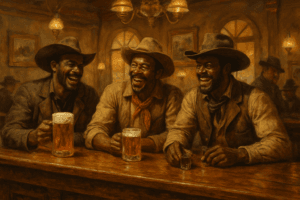
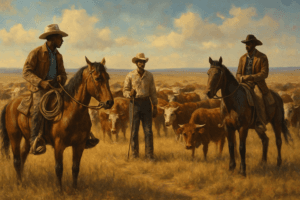
While often overlooked in popular culture, Black cowboys played a significant and vital role in the history of the American West. Historians estimate that as many as one in four cowboys were Black, a testament to both their prevalence and the critical roles they assumed in the everyday operations of ranches, cattle drives, and frontier settlements. Black cowboys worked as wranglers, drovers, cooks, and trail bosses, demonstrating expertise, resilience, and resourcefulness that earned them respect among their peers, even if mainstream recognition remained elusive. Despite their undeniable presence, Black cowboys routinely faced the harsh realities of racism and segregation. Jim Crow laws and social prejudice often barred them from certain lodgings, restaurants, and even competitions, and they were frequently denied the accolades and opportunities afforded to their white counterparts. Yet, the frontier also offered a degree of freedom and possibility that was difficult to find elsewhere in post-Civil War America. On the open range, skill, tenacity, and character could, at least in part, transcend color lines, allowing Black cowboys to carve out livelihoods and, in some cases, local legends.
Nat Love, one of the most famous Black cowboys, chronicled his experiences in his 1907 autobiography, providing a rare first-person account of this era. Love wrote, “It was not an uncommon thing for men to ride a hundred miles for a good cowboy, and when found they paid him well, regardless of color or creed.” His words reflect both the demand for skilled labor and a begrudging meritocracy that sometimes prevailed on the frontier. Love also recounted episodes of discrimination, yet he emphasized the camaraderie and respect that could develop among men who faced the perils of the trail together. “On the range, a man was valued for what he could do,” Love recalled, “not for the color of his skin.” Through stories like Nat Love’s, it becomes clear that Black cowboys were not only present in the West—they were integral to shaping its legacy, demonstrating resolve and humanity amid both opportunity and adversity.
Nat Love’s story stands as a powerful testament to the rich diversity that shaped the American West—one that has too often been overlooked or forgotten in popular culture and mainstream histories. By including Black cowboys like Nat Love in our understanding of this era, we gain a fuller, more accurate picture of the West as a place where people of all backgrounds sought opportunity, adventure, and freedom. Nat Love was more than just a cowboy; he was a skilled rider, a sharp marksman, and a storyteller whose accounts challenged the narrow narratives that have dominated textbooks and Hollywood films for generations. His life reminds us that the West was not solely the domain of white cowboys, but a dynamic, multicultural landscape where Black Americans, Mexican vaqueros, Native peoples, Chinese laborers, and many others played essential roles.
Recognizing and celebrating stories like Nat Love’s is not just about setting the historical record straight—it’s about inspiring current and future generations to see themselves reflected in the American story. When we embrace and share histories that reflect the true diversity of our past, we open the door to greater understanding, empathy, and unity. Nat Love’s courage and resilience exemplify the best of the American spirit: a willingness to break barriers, pursue dreams, and claim one’s rightful place in the world, even in the face of adversity. As we move forward, let us commit to seeking out and uplifting voices that have been marginalized or forgotten, ensuring that our shared history is as vibrant and inclusive as the people who lived it.
To echo the words Nat Love himself once wrote, “I have been in the saddle since I was a boy, and I expect to die in it.” This spirit of perseverance and authenticity is what makes Nat Love an enduring American original. His legacy invites us all to look beyond the myths, to value the real stories that make up our nation’s past, and to honor the contributions of all those who helped build the American West.
About The Author