Unveiling Africa’s Golden Past: Exploring the Rich History of the Mali and Songhai Empires
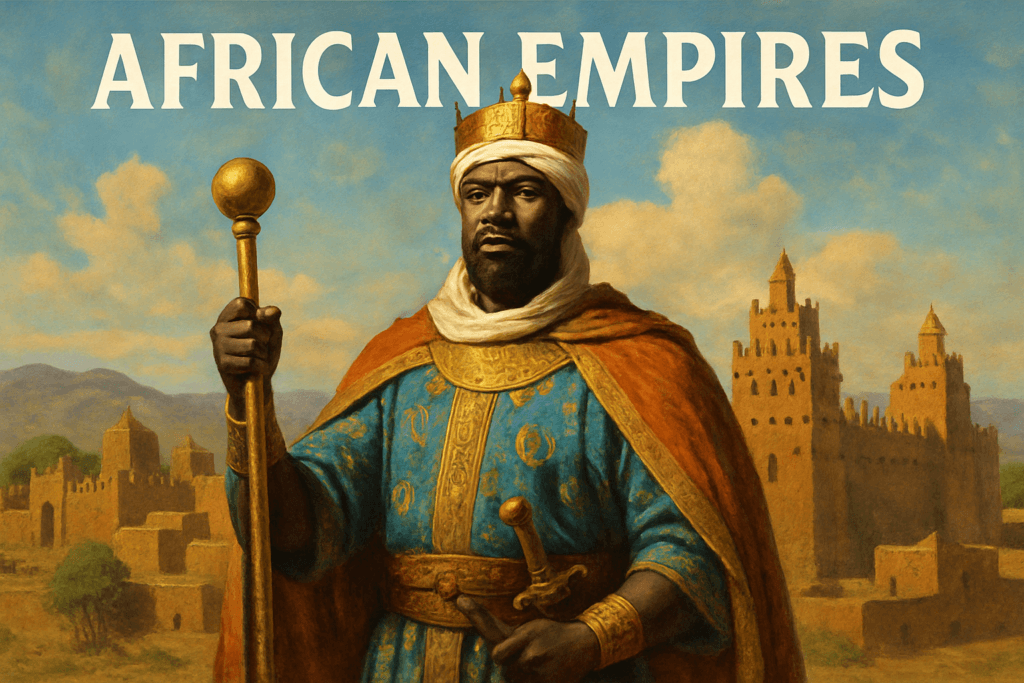
Imagine standing at the edge of a sun-soaked desert, where caravans laden with gold dust wind their way toward thriving cities that shimmer on the horizon. In these vibrant urban centers, the air thrums with the sound of animated debate as scholars gather to exchange ideas, recite poetry, and unravel the mysteries of philosophy and science. Nearby, opulent palaces rise above crowded marketplaces, home to kings whose legendary wealth drew the awe—and envy—of distant Europe. This was not a distant corner of the world, but medieval West Africa, a region that flourished as a beacon of learning, commerce, and culture. What forces transformed this land into a center of such remarkable prosperity and intellectual achievement? How did it foster societies where knowledge and gold flowed with equal abundance? At the heart of this golden age were the Mali and Songhai Empires, realms whose extraordinary legacies have often been overshadowed or forgotten in mainstream history. Their stories invite us to rediscover a time when West Africa stood proudly among the world’s great civilizations.
The rise, glory, and enduring legacy of Mali and Songhai represent a golden era in West African history, marked by immense wealth, cultural brilliance, and political influence that resonated far beyond the continent. Emerging in the 13th century, the Mali Empire ascended under the astute leadership of Sundiata Keita, who united disparate tribes and laid the foundations of a unified state. Mali’s prosperity flourished through its control of lucrative trans-Saharan trade routes, dealing in gold, salt, and other precious commodities that attracted traders from as far as North Africa and the Middle East. The empire reached its zenith during the reign of Mansa Musa, whose pilgrimage to Mecca in 1324 showcased Mali’s opulence to the wider Islamic world. His generous distribution of gold along the way not only cemented Mali’s reputation as a land of immense riches but also fostered diplomatic and economic connections with other great civilizations.
Cultural and intellectual advancements thrived in Mali’s heartland, especially in Timbuktu and Gao, where grand mosques, libraries, and universities became centers of learning and scholarship. Scholars from across Africa and the Middle East flocked to these cities, contributing to a vibrant intellectual community that produced works in astronomy, mathematics, law, and literature. The architectural marvels, such as the Djinguereber Mosque, stand as lasting testaments to the region’s artistic and religious achievements.
As Mali’s power waned in the late 15th century, the Songhai Empire rose to prominence, building upon its predecessor’s traditions while expanding its territory and influence. Under rulers like Sunni Ali and Askia Muhammad, Songhai established one of the largest and most powerful empires in African history. They maintained sophisticated administrative systems, a formidable military, and promoted religious tolerance and scholarship. Trade continued to flourish, making cities like Timbuktu and Jenne vital economic and cultural hubs.
The legacies of Mali and Songhai endure in the collective memory and cultural fabric of West Africa. Their achievements in governance, commerce, education, and the arts forged an identity of resilience and ingenuity that continues to inspire. Their stories challenge misconceptions about Africa’s past, revealing a region that was once the seat of great empires whose influence reached across continents and centuries.
The Mali Empire, one of West Africa’s most illustrious pre-colonial civilizations, traces its origins to the early 13th century under the leadership of Sundiata Keita. Rising from the small kingdom of Kangaba, Sundiata united a coalition of Mandinka chiefs to overthrow the oppressive Sosso king, Sumanguru Kanté. His triumph and the subsequent founding of the empire are immortalized in the celebrated “Epic of Sundiata,” an oral tradition that continues to shape Malian identity today. As Mali expanded, it developed a sophisticated system of governance, characterized by a hierarchical social structure that included nobles, free people, artisans, and enslaved individuals. Administration relied heavily on oral historians, or griots, who preserved laws, genealogies, and cultural values, ensuring continuity and cohesion across the vast and diverse empire.
Under the reign of Mansa Musa (1312–1337), Mali reached the zenith of its power and prestige. Mansa Musa is best known for his legendary pilgrimage to Mecca in 1324, during which he traveled with a lavish entourage and distributed so much gold that he reportedly destabilized local economies along his route. This journey not only showcased Mali’s extraordinary wealth but also established diplomatic and cultural connections with North Africa and the broader Islamic world. Upon his return, Mansa Musa invested in the construction of grand mosques and madrasas, particularly in the city of Timbuktu, which became a renowned center of Islamic scholarship, attracting students and scholars from across Africa and beyond.
Mali’s prosperity rested on its control of lucrative trans-Saharan trade routes, particularly those dealing in gold and salt. Timbuktu, Djenné, and Gao flourished as commercial and intellectual hubs, facilitating the exchange of not just goods but also ideas and manuscripts. The wealth generated from these networks funded architectural achievements and supported a vibrant cultural life, as evidenced by the manuscripts and learning centers that survive to this day.
However, by the late 14th and 15th centuries, the Mali Empire began to decline. Internal disputes and succession crises weakened central authority, while external pressures from emerging powers such as the Songhai Empire eroded Mali’s territorial control. Changing trade routes and shifting alliances further destabilized the empire, leading to its gradual fragmentation and the rise of new political entities in West Africa. Despite its decline, the legacy of Mali endures in the region’s culture, scholarship, and historical consciousness.
The Songhai Empire emerged as the preeminent power in West Africa during the 15th and 16th centuries, building upon the legacies of earlier states like Ghana and Mali. After the decline of the Mali Empire, Songhai’s small riverine kingdom, centered around the city of Gao, began its transformation into an expansive empire. This rise was propelled by ambitious rulers, most notably Sunni Ali, whose military prowess enabled Songhai to capture key trading cities such as Timbuktu and Djenné. These victories not only expanded Songhai’s territory but also placed its rulers at the heart of trans-Saharan commerce, allowing them to dominate crucial gold, salt, and slave trade routes. Sunni Ali’s successor, Askia Muhammad, further consolidated and expanded the empire, instituting sweeping administrative reforms that strengthened central authority and enhanced the efficiency of governance. Under Askia’s leadership, Songhai developed a sophisticated bureaucracy, codified legal systems, and introduced new policies that balanced Islamic principles with respect for indigenous beliefs and customs, fostering both stability and unity among its diverse populations.
Economically, Songhai’s prosperity rested on its control of major trade arteries and fertile agricultural lands along the Niger River. The empire’s cities burgeoned into bustling commercial hubs, attracting merchants from across Africa and beyond. Agricultural advancements supported population growth and urbanization, fueling further economic development. Songhai’s commitment to learning and scholarship was equally notable: the city of Timbuktu, home to the renowned University of Sankore, became a beacon of intellectual achievement. Scholars from across the Islamic world flocked to Songhai’s centers of learning, contributing to advancements in theology, mathematics, astronomy, and law, and producing manuscripts that are treasured to this day.
Despite its power and achievements, the Songhai Empire eventually faced decline. Internal strife erupted as rival factions vied for control, leading to civil wars that weakened central authority. This vulnerability was exploited in 1591 when Moroccan forces, equipped with firearms and advanced military technology, invaded and defeated Songhai’s armies, marking a decisive end to the empire’s dominance. The fall of Songhai underscores the critical impact of technological change and internal unity on the fate of empires, as well as the enduring legacy of its cultural and economic contributions to West African history.
The empires of West Africa have left a profound and enduring legacy that continues to shape the region’s cultural, linguistic, and architectural landscape. The influence of powerful kingdoms such as Ghana, Mali, and Songhai can still be seen in the languages spoken today, with many West African tongues incorporating words and expressions that date back to these early civilizations. Architectural marvels such as the mud-brick mosques of Timbuktu and Djenné stand as testaments to the ingenuity and artistry of their builders, blending indigenous techniques with Islamic motifs. These structures not only served religious purposes but also became centers of learning and community life, symbolizing the sophistication of West African societies.
A pivotal aspect of this legacy was the spread of Islam, which took root and flourished through the trade routes that crisscrossed the Sahara. As Islam became intertwined with local traditions, it fostered the growth of scholarship and learning, most notably in cities like Timbuktu, which housed renowned universities and libraries. These centers attracted scholars from across the Islamic world, facilitating an exchange of ideas that enriched both West Africa and distant lands. Manuscripts from this era, covering subjects from astronomy to law, bear witness to the intellectual vibrancy of the region and challenge lingering stereotypes of a precolonial Africa devoid of written history or advanced knowledge.
Despite these achievements, the global perception of West African empires has often been clouded by myths, legends, and historical neglect. Stories of fabulous wealth, such as the legendary pilgrimage of Mansa Musa, sometimes overshadow the nuanced realities of these societies. For centuries, colonial narratives marginalized African achievements, relegating them to the realm of myth rather than acknowledging them as historical fact. However, ongoing scholarship and the rediscovery of Africa’s past have begun to correct these misperceptions, highlighting the complexity and dynamism of West African civilizations.
Today, the legacies of these empires play a key role in shaping contemporary African identity and pride. Efforts to reclaim and celebrate this heritage have inspired movements in art, literature, and education, empowering new generations to draw strength from their history. The enduring impact of West Africa’s golden age serves as a source of inspiration, reminding Africans and the world of the continent’s significant contributions to global history and culture.
West Africa, a region stretching from the Atlantic coastline deep into the interior of the continent, has long been a crossroads of cultures, commerce, and civilizations. Nestled between the Sahara Desert to the north and lush forests to the south, this area served as a bridge connecting North Africa, the Mediterranean, and sub-Saharan Africa. Ancient trade routes crisscrossed its vast savannahs, making it a vibrant hub for the exchange of goods, ideas, and innovations. At the heart of this network were two commodities that would shape the destiny of entire empires: gold and salt. Gold, mined in abundance from the river valleys and forests of West Africa, was highly prized across Europe and the Islamic world. Meanwhile, salt, essential for preserving food and maintaining health in the arid climate, was transported south from the Sahara in long caravans. The wealth generated from this trade laid the foundation for some of the most remarkable civilizations in African—and world—history.
The Mali and Songhai Empires emerged as titans of their era, commanding vast territories and influencing the course of global events. The Mali Empire, flourishing between the 13th and 16th centuries, established its capital at Niani and is perhaps best known for the legendary city of Timbuktu. Timbuktu, along with other cities like Gao and Djenné, became renowned centers of learning, attracting scholars, poets, and traders from across Africa and beyond. Following Mali’s decline, the Songhai Empire rose to prominence in the 15th and 16th centuries, with Gao as its capital. Under rulers such as Askia Muhammad, Songhai expanded its reach and consolidated control over key trade routes, ensuring the continued prosperity of the region.
The legacies of Mali and Songhai extend far beyond their golden ages. Their achievements in governance, scholarship, and commerce helped shape the development of modern Africa and influenced the wider world. Today, their stories offer vital insights into the interconnectedness of global history, the richness of African heritage, and the enduring importance of learning and trade. By exploring the rise and fall of these golden empires, we gain not only a deeper appreciation for Africa’s past but also a better understanding of the shared roots of modern civilization.
The legacies of the Mali and Songhai Empires reverberate through the ages, standing as enduring testaments to Africa’s brilliance, resilience, and boundless capacity for innovation. Both empires rose to prominence through visionary leadership, dynamic trade networks, and a commitment to scholarship and culture that left an indelible mark not only on West Africa but on the broader world. The Mali Empire, under the illustrious Mansa Musa, dazzled the globe with its unimaginable wealth and devotion to learning, as seen in the legendary libraries and universities of Timbuktu. Meanwhile, the Songhai Empire, at its zenith under Askia Muhammad, became a model of administrative sophistication and religious tolerance, governing vast territories and nurturing a vibrant urban life along the Niger River.
These stories remind us that Africa has always been a central player in the grand tapestry of world history. The architectural marvels, complex systems of governance, and flourishing centers of knowledge that defined these empires challenge outdated stereotypes and demand a deeper appreciation for the continent’s contributions to global civilization. Their influence reached far beyond their borders, forging connections with Europe, the Middle East, and beyond, shaping the very foundations of trade, science, and culture.
As we reflect on the echoes of these empires, let us recognize the importance of seeking out and celebrating Africa’s rich histories. Too often, narratives about the continent have been shaped by outside perspectives, obscuring the profound achievements of societies like Mali and Songhai. By exploring these stories, we not only honor the ancestors who built them but also inspire future generations to take pride in their heritage and challenge the narrow views that persist today.
Let this journey spark curiosity and a commitment to learning more. Seek out the voices of African historians, listen to the wisdom preserved in oral traditions, and question the limits of what you thought you knew. As a West African proverb wisely states, “Until the lion tells his side of the story, the tale of the hunt will always glorify the hunter.” By remembering and celebrating the grandeur of Mali and Songhai, we can help ensure that the true richness of Africa’s past—and its ongoing impact on our world—are never forgotten.
About The Author